Visibility
Did AI recommend your practice?
When I ask a patient question, does the AI service mention your practice, recommend it, or leave it out? I record which service I tested and when.
AI visibility & accuracy
When a patient asks Google or AI for an eye doctor, the answer should be built on facts you’ve confirmed. GSA organizes and verifies the facts about your doctors, services, insurance and location, and checks how AI describes your practice.
I build each website with pages that answer real patient questions, structured data that spells out who the practice is, listings that match, and regular checks of what AI says. The goal is to help patients find your practice and understand why it may be right for them.
A practice can appear in an AI answer and still be described incorrectly. It can also have a correct website and still be omitted, summarized from stale information, or represented differently across systems.
What GSA doesI verify your practice facts with you, keep your website and the public profiles I can update clear and current, and give search and AI services time to pick up the changes. Then I ask the same patient questions again to see whether the answers changed.
A real example
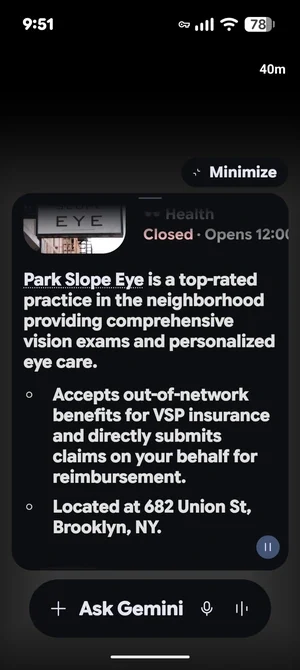
Park Slope Eye already had strong visibility on Google. Yet on launch evening, when I asked Gemini patient questions, it described the practice’s VSP and EyeMed participation incorrectly.
What I check
Both matter when a patient asks AI whom to call, whether a plan is accepted, which services you offer, or what to expect before booking.
Visibility
When I ask a patient question, does the AI service mention your practice, recommend it, or leave it out? I record which service I tested and when.
Accuracy
Doctors, location, services, hours, vision plans, insurance, policies and how to book can matter more than just being mentioned.
Consistency
One good answer does not mean the practice will always be recommended or described correctly. Repeating the same questions can reveal outdated or conflicting answers.
Start with the practice
I keep a record of the facts you’ve confirmed, the ones patients need before choosing care, and check what AI says against it.
When something is wrong
I check three things separately: what I corrected, whether search services picked up the change, and what AI now tells patients.
1Correct the facts
I correct wrong, outdated or conflicting information on the practice website and other sources the practice is allowed to update.
2Check for the update
Publishing a correction does not mean every service has seen it. Where I can check, I look for the updated information instead of assuming it has reached every system.
3Check the AI answer
After allowing time for the update, I ask the same question in the same AI service, save the new answer and compare it with the original. A better answer today doesn’t guarantee every future answer.
Evidence before folklore
Google, ChatGPT and other services do not all work the same way. I start with each company’s own published guidance, like Google’s guide to AI features and your website ↗ (opens in a new tab). When it does not explain something important, I test what happens and state what I still do not know.
Showing up on Google, AI reading your website to answer a patient, and AI companies training their models are three different things. A tactic aimed at one may not help the others.
No single file, piece of structured data, website setting or other technical change can guarantee how an AI system ranks, cites, recommends or describes your practice.
Questions for any vendor
Ask which services and patient questions were tested, what was found, and whether the vendor can show you the original answers and the results after any changes.
Which AI/search products, which patient questions, which dates, and under what test conditions?
How do you know the provider, service, insurance, hours or policy fact you are judging is actually current?
Do you look for outdated or conflicting information, correct what you can update, and ask the same question again to check the result?
Can you show the website correction, whether search services picked it up, and what AI tells patients now? Those are separate checks.
Ask what the AI or search company itself says, what the vendor has tested, and what is still only an assumption.
No credible vendor can guarantee a top position, every AI recommendation, or how many appointments or how much revenue the work will produce.
I hold GSA to the same six questions. I repeat the same planned tests, keep the evidence, and your Practice Pulse report shows what I found, what matters, and what I’m doing about it.
Two ways to start
Your part takes a few hours. I do the research, writing, building and monthly care, just as I do for my own practice.
Founding Practice offer
$500 one-time + $149/month for 12 months.
I was paying about $1,000 a month before I built this.
Not sure yet?
Free AI Snapshot

Justin Bazan, OD · Optometrist and practice owner.
You work directly with me. Questions first? Email me